Vision-Related Services
Vision Loss Adjustment Training
We provide rehabilitation training that is tailored to each individual’s unique needs, experiences, and current life and/or employment situation.
In New Zealand, low vision is generally defined as having visual acuity of 6/24 or less in the better eye with corrective lenses, or a visual field of 20 degrees or less.
For reference, under the Supported Living Payment (SLP) system, a person is considered totally blind if their visual acuity is worse than 3/60 — though this is a separate classification from low vision.
What Qualifies as Low Vision
Key Criteria for Low Vision in New Zealand
You may qualify for low vision support if you meet one of the following criteria, as confirmed by a registered eye-care professional:
Distinction from Blindness (for Support Purposes)
While the threshold for low vision is 6/24, a different standard applies when determining eligibility for the Supported Living Payment (SLP):
Important Considerations
Low Vision Adaption
The Centre-based program activity is designed to meet unique needs of clients with low vision. Clients are encouraged to explore the range of their visual abilities and to establish visual independence.
Independent Life Skills
The program provides the clients the opportunity to develop and practice skills of independent living through experience-appropriate, high-interest themes.
Assistive Technology
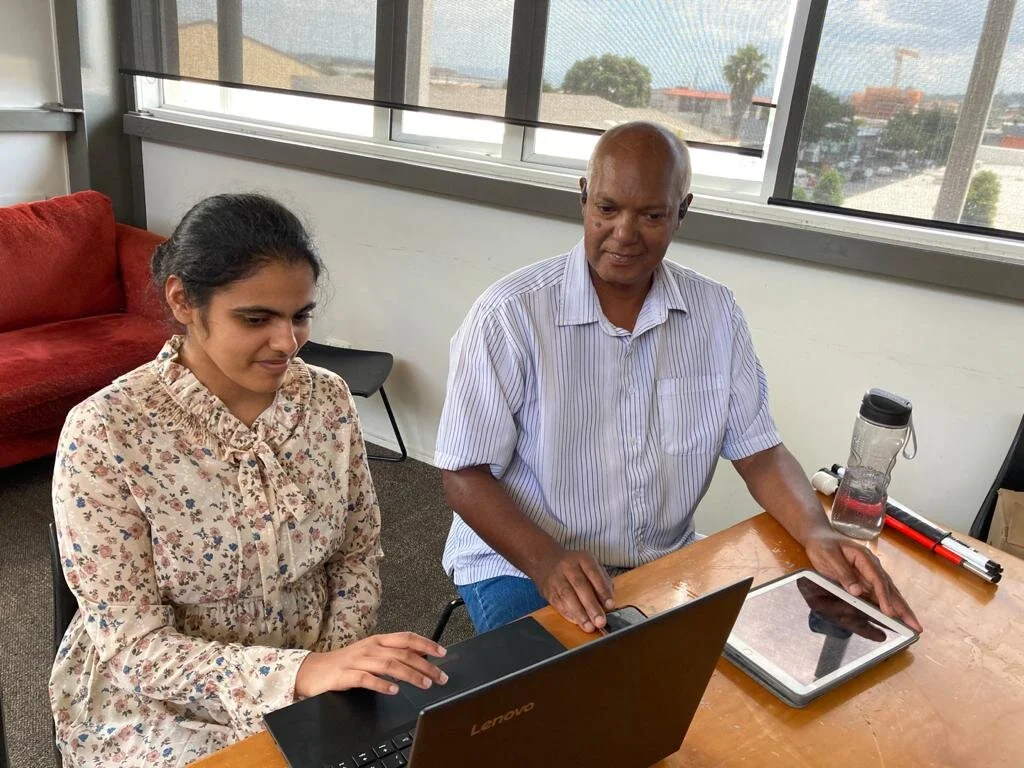
Training may include alternative methods for accessing information such as technology concepts, tools, and skills for visual and non-visual learners
Orientation and Mobility
Orientation and Mobility (O&M) training plays a crucial role in teaching people with visual impairments to travel independently and safely.
It helps individuals build confidence in navigating different environments, learning skills such as using a white cane, understanding spatial awareness, identifying landmarks, crossing roads, and using public transport.
IAT
Individual Adjustment Training
We provide the following adaptation programs and specialised skills in becoming independent at home, in the community, and in employment.
Rehabilitation training is tailored to each individual’s unique needs, experiences, and current life and/or employment situation.
Training services are either provided at home, in the local community, or at a designated training facility.
(During iAT training, instructors work with the individual to determine the most appropriate adaptive equipment and/or resources for their unique needs.)